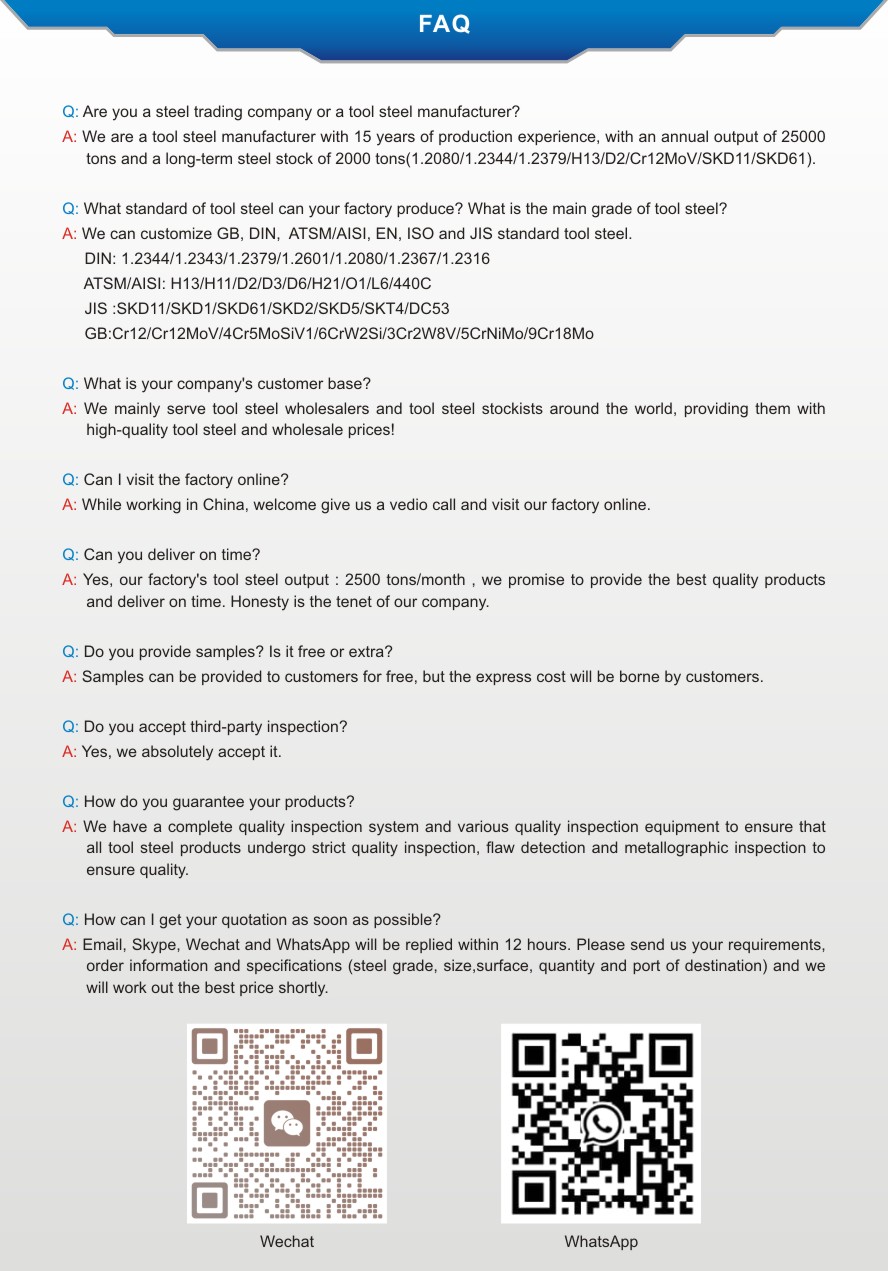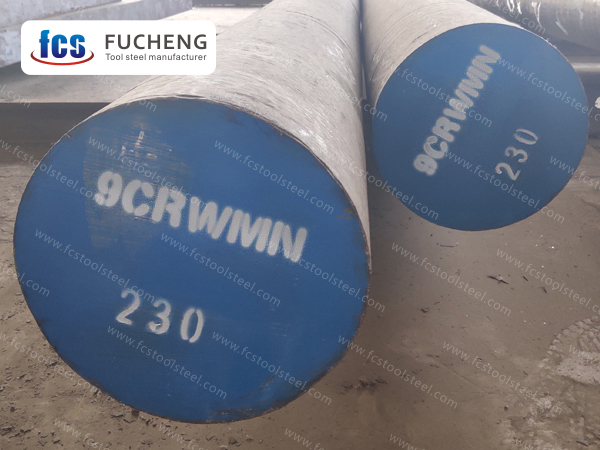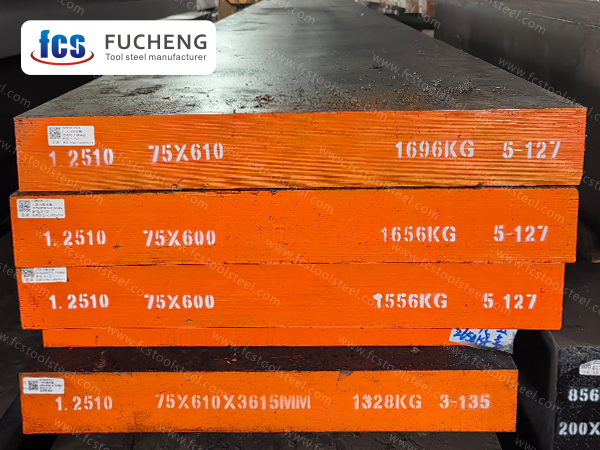

FCS O1 Tool Steel | 1.2510 | 100MnCrW4 | SKS3
O1 mold steel is widely used. O1 steel has good processability, good wear resistance, stable O1 heat treatment performance, small dimensional deformation, but weak toughness and corrosion resistance. It is commonly used in blanking die, punching die, punching die, punching die, etc.
- fucheng steel
- China
- 1 Month
- 2000 Tons/Month
O1 STEEL
| Brand | FCS |
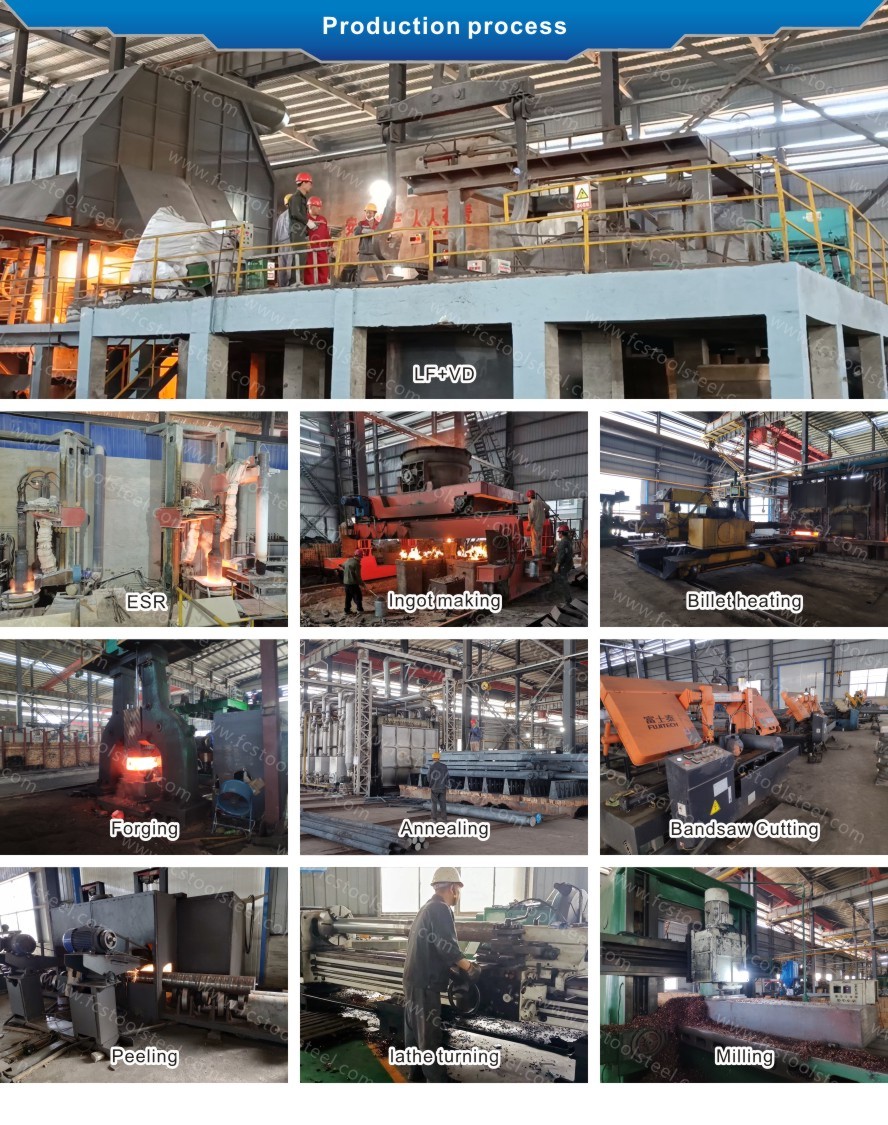
| Smelting and Manufacture Method: | LF+VD+Forged |
| Delivery Condition: | Annealed |
| Delivery hardness: | ≤230 HBS |
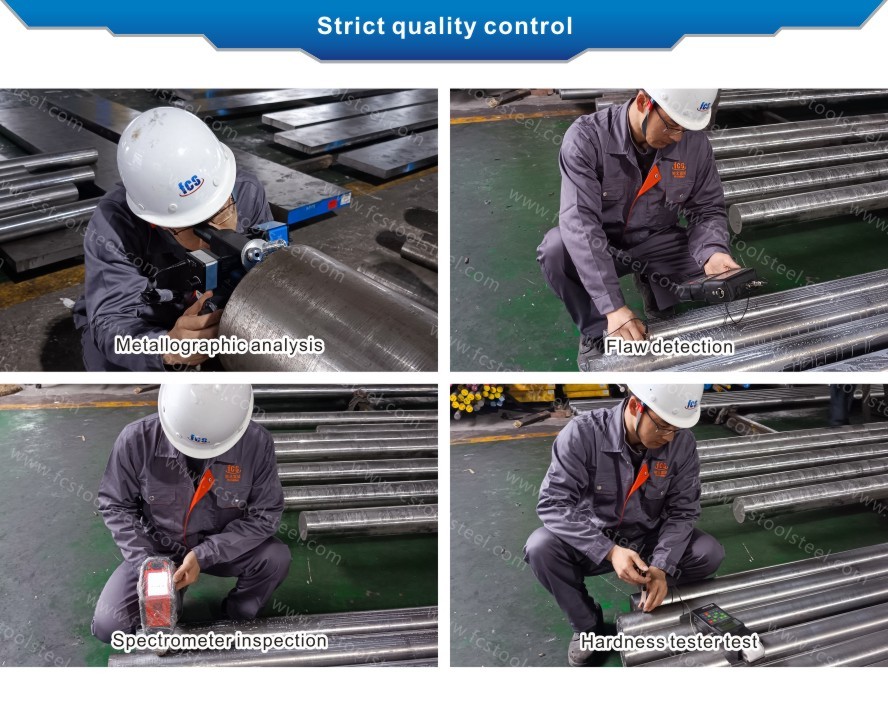
| UT Test Standard: | Sep 1921-84 Class3 D/d,E/e |
O1 STEEL GRADE COMPARISON AND CHEMICAL COMPOSITION COMPARISON
| Standard/Steel Grade | Chemical Composition(%) | ||||||
| C | Si | Mn | Cr | V | W | ||
| ASTM | O1 | 0.85~1.00 | 0.10~0.50 | 1.00~1.40 | 0.40~0.60 | ≤0.30 | 0.40~0.60 |
| DIN/W-Nr. | 100MnCrW4/1.2510 | 0.90~1.05 | 0.15~0.35 | 1.00~1.20 | 0.50~0.70 | 0.05~0.15 | 0.50~0.70 |
| JIS | SKS3 | 0.90~1.00 | ≤0.35 | 0.90~1.20 | 0.50~1.00 | - | 0.50~1.00 |
APPLICATION
O1 steel has outstanding performance in tool manufacturing, with a high hardness of 60-62 HRC and excellent wear resistance, making it the preferred material for cutting tools such as milling cutters and drills, especially suitable for processing wood and non-ferrous metals. The O1 steel oil quenching process endows it with good dimensional stability and can maintain the sharpness of the cutting edge for a long time.
In terms of mold applications, O1 steel has become an ideal material for cold work molds due to its uniform organizational structure, and is widely used in the manufacturing of hardware molds such as punching molds and bending molds. The low non-metallic content characteristic of O1 steel can also achieve high-precision skin texture reproduction, which is suitable for precision plastic mold manufacturing.
O1 steel is equally important in the field of mechanical parts, commonly used in key components such as bearing rings and precision measuring tools. By adjusting the tempering temperature between 150-400 ℃, O1 steel can precisely optimize its hardness and toughness, meeting the stringent requirements in fields such as automotive and aerospace.
O1 STEEL CHARACTERISTICS
O1 mold steel is a widely used oil quenched hardening tool steel with good wear resistance and processing performance. Due to its stable heat treatment performance, its dimensional deformation is very small. In addition, O1 steel has a good distribution of carbides and small particles, which helps to improve its wear resistance. In addition, the steel has good hardenability and small quenching deformation.
In practical applications, O1 steel exhibits excellent characteristics. Firstly, due to its characteristics of spheroidizing, annealing, and softening of the microstructure, it is easy to carry out cutting processing. Secondly, quenched O1 steel has high hardness and good dimensional stability after tempering. In addition, for hardened steel, softening annealing can be used to improve its cutting performance; The precision mold after rough machining needs to undergo stress relief annealing treatment.
In terms of hardness and wear resistance, ASTM O1 tool steel is considered to have deep hardening characteristics and fine grain structure, exhibiting excellent wear resistance and toughness. In practical applications, O1 steel is often used in hardware molds such as punching dies, stamping dies, bending dies, drawing dies, piercing punches, and finishing dies. However, it is worth noting that although O1 steel performs well in wear resistance and dimensional stability, its toughness and corrosion resistance are relatively weak.
O1 steel is widely used due to its excellent processing performance, wear resistance, and stable heat treatment performance. However, attention should also be paid to the limitations of its strength and corrosion resistance when using it.
PHYSICAL PARAMETERS
| Parameter Name | Standard Value |
|---|---|
| Density at Room Temperature | approx. 7.8~7.83 g/cm³ |
| Melting Point | approx. 1421°C |
| Thermal Conductivity at Room Temperature | approx. 33.0~40 W/(m·K) |
| Specific Heat Capacity | approx. 0.46 J/g·°C |
| Average Linear Thermal Expansion Coefficient (20-200°C) | approx. 12.9×10⁻⁶/℃ |
| Elastic Modulus | approx. 193~214 GPa |
O1 Steel is an oil-hardening tool steel with excellent machinability and good wear resistance. After heat treatment, O1 Steel has excellent dimensional stability, and its deformation rate is much lower than that of similar water-quenched tool steels. It can reach a maximum hardness of HRC 62 only by oil quenching. It has good edge retention and is easy to finely grind and polish, making it suitable for processing parts with complex sections and shapes.
HEAT TREATMENT PROCESS
Annealing Process
Softening Annealing: It is suitable for softening O1 Steel before processing. Heat uniformly to 770~780°C for heat preservation, then cool with the furnace at a rate of ≤15°C/hour to 650°C, then air cool to room temperature. After annealing, the hardness of O1 Steel is about 190~229 HB, which meets the requirements of cutting processing.
Stress Relief Annealing: It is suitable for eliminating the internal stress of O1 Steel after rough machining. Heat to 600~650°C for heat preservation for 2~4 hours, cool slowly to below 500°C and then air cool, which can reduce the risk of quenching deformation and cracking of O1 Steel in the subsequent process.
Quenching Process
Preheating: Preheat at 300~500°C first. For large-size O1 Steel workpieces, secondary preheating can be carried out at 600~650°C to reduce thermal stress.
Austenitization: Heat uniformly to 780~850°C for full penetration. Calculate the holding time based on 30 minutes of heat preservation per 25mm of effective section.
Cooling: Adopt oil quenching, and warm oil at 50~80°C is recommended to ensure uniform cooling. When the temperature of the O1 Steel workpiece drops to 50~70°C, take it out immediately. Do not cool to room temperature to avoid quenching cracking. Tempering must be carried out immediately after taking out.
Tempering Process
The tempering temperature is adjusted according to the target hardness of O1 Steel. The holding time is at least 1 hour per inch of thickness, with a minimum holding time of 2 hours. For large-size O1 Steel workpieces, tempering twice is recommended to improve stability. The corresponding relationship between hardness and temperature is as follows:
| Tempering Temperature | Hardness after Tempering (HRC) | Typical Application Scenarios |
|---|---|---|
| 100~150°C | 62~64 | Thin-blanking dies, precision cutting tools of O1 Steel |
| 180~200°C | 60~62 | High-precision measuring tools (calipers, plug gauges) |
| 200~250°C | 59~61 | Ordinary stamping dies |
| 250~300°C | 57~59 | Forming dies such as bending dies and drawing dies |
| 300~350°C | 55~56 | Punches requiring high toughness |
Additional optimization process: After quenching of O1 Steel,
cryogenic treatment at -70~-80°C for 3~4 hours immediately can
additionally increase the hardness by 1~3HRC. However, this method is
not recommended for O1 Steel workpieces with complex shapes to prevent cracking.