
S7 Tool Steel
- fucheng steel
- China
- 1 Month
- 2000 Tons/Month
S7 STEEL
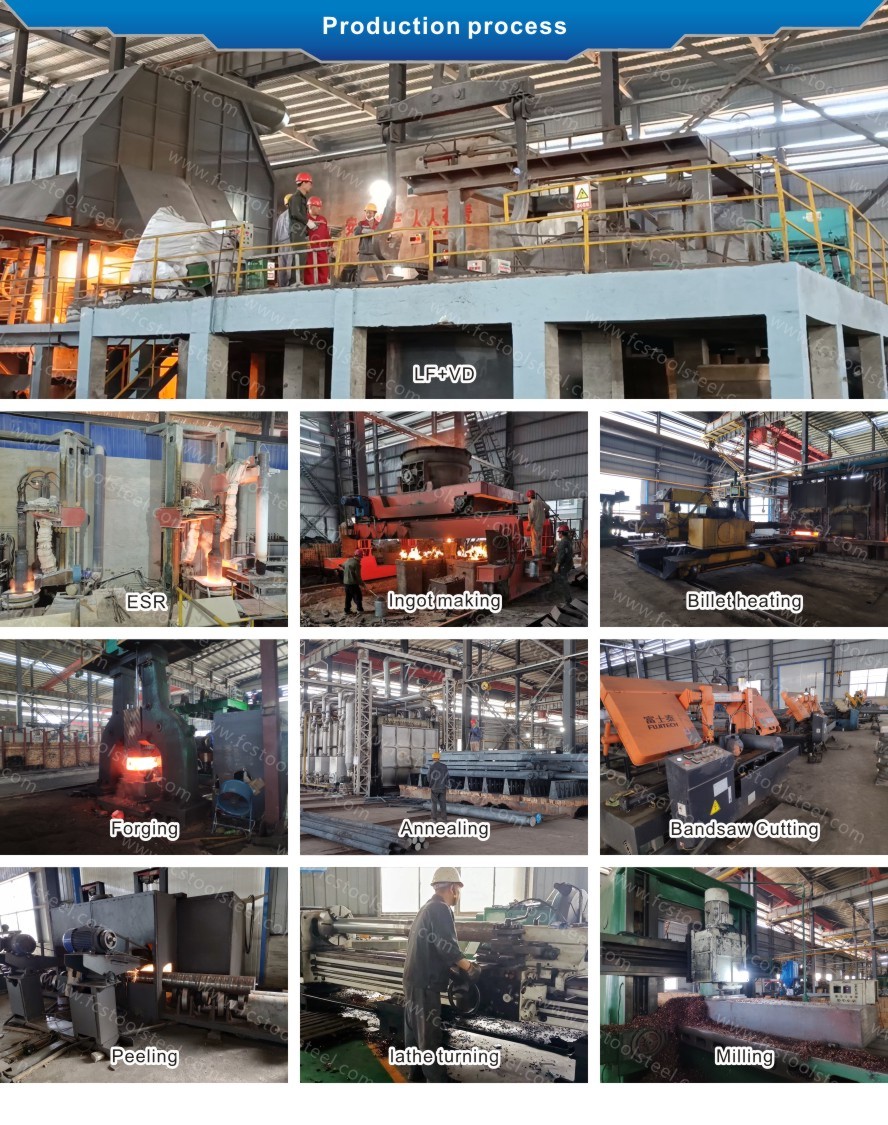
| Smelting and Manufacture Method: | LF+VD+Forged |
| Delivery Condition: | Annealed |
| Delivery hardness: | ≤229 HBS |
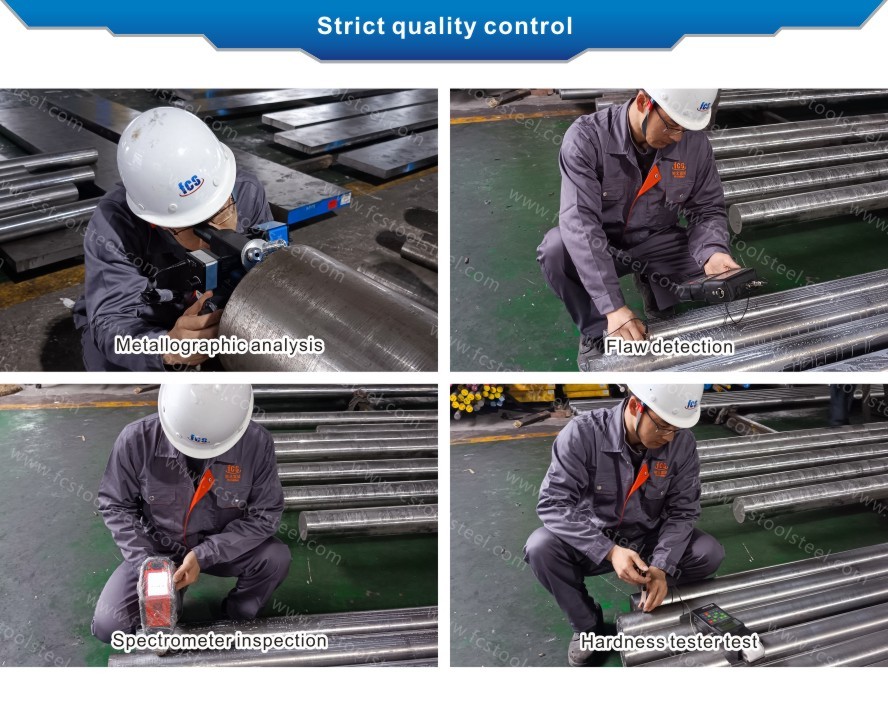
| UT Test Standard: | Sep 1921-84 Class3 D/d,E/e |
S7 STEEL GRADE COMPARISON AND CHEMICAL COMPOSITION COMPARISON
| Standard/Steel Grade | Chemical Composition(%) | ||||||
| C | Si | Mn | Cr | Mo | V | ||
| ASTM | S7 | 0.45~0.55 | 0.20~1.00 | 0.20~0.90 | 3.00~3.50 | 1.30~1.80 | ≤0.35 |
| GB | 5Cr3Mn1SiMo1V | 0.45~0.55 | 0.20~1.00 | 0.20~0.90 | 3.00~3.50 | 1.30~1.80 | ≤0.35 |
APPLICATION
S7 is impact resistant tool steel, which can be used as punching or punching tools, shear dies, hot forging dies, die casting dies of fusible alloys, and blades for hot and cold metal shearing.
S7 STEEL CHARACTERISTICS
S7 steel is a high-quality chromium molybdenum alloy tool steel with many excellent characteristics. As a type of steel with high hardness and wear resistance, S7 steel has been widely used in many fields.
Firstly, S7 steel has excellent hardenability. This enables it to quickly achieve the required hardness and strength during the heat treatment process, and has high toughness. This hardenability makes S7 steel an ideal choice for manufacturing various cutting tools, punches, and molds. Whether used for cutting, stamping, or forming, S7 steel can provide excellent performance and durability.
Secondly, S7 steel has high strength and tempering stability. It has high tensile strength and yield strength, and can maintain its strength and hardness even in high temperature environments. This makes S7 steel very useful in manufacturing tools that need to withstand high loads and impacts. Whether used as cutting tools for heavy-duty machinery or high-strength parts in automotive manufacturing, S7 steel can provide excellent performance.
In addition, S7 steel also has high impact toughness and wear resistance. Its toughness makes it less prone to fracture or deformation when subjected to impact, thereby extending its service life. Meanwhile, the surface of S7 steel has good wear resistance, enabling it to maintain good performance in high-speed cutting and wear environments. This makes S7 steel an ideal choice for manufacturing cutting tools, punches, and molds.
In addition, S7 steel also exhibits high hardening and softening resistance. Its hardness can be precisely controlled during the heat treatment process to meet different application requirements. This makes S7 steel very suitable for manufacturing tools that require specific hardness and strength. At the same time, S7 steel also has excellent softening resistance, which can maintain its hardness and strength even at high temperatures, thereby extending its service life.
In addition, S7 steel also exhibits excellent mechanical fatigue resistance. It can maintain stable performance under repeated loads and is less prone to fatigue fracture. This gives S7 steel a great advantage in manufacturing tools and parts that require long-term use. Whether used as cutting tools for mechanical equipment or key components of automotive engines, S7 steel can provide reliable performance.
Finally, S7 steel also possesses high toughness and medium temperature oxidation resistance. Its toughness makes it less prone to fracture or deformation under impact, providing a longer service life. At the same time, S7 steel has good oxidation resistance in the medium temperature range and can resist the influence of oxidation corrosion. This makes S7 steel not only suitable for manufacturing tools and dies that work at higher temperatures, but also for manufacturing parts that are used at moderate temperatures.
PHYSICAL PROPERTIES
| Performance Index | Specific Parameter |
|---|---|
| Density | 7.83 g/cm³ (7833 kg/m³) |
| Specific Gravity | 7.83 |
| Elastic Modulus | 207 GPa (30×10⁶ psi) |
| Thermal Conductivity | 28.5 W/m·K (16.5 BTU/hr-ft-°F) |
| Machinability | 70-75% of that of ordinary 1% carbon steel |
| Critical Temperature | Ac1: 793℃, Ac3: 838℃, Ar1: 754℃, Ar3: 710℃ |
| Application Hardness After Quenching and Tempering | 52-58 HRC (up to 60-61 HRC) |
High impact toughness: Even at high hardness, S7 steel
still maintains excellent toughness. S7 steel is suitable for working
conditions with frequent impact, and the toughness performance of S7
steel is better than most cold-work tool steels.
Softening resistance and stability: When S7 steel works at a temperature not exceeding 538℃, S7 steel can maintain stable hardness and performance.
Good wear resistance: After S7 steel is processed by
remelting process, there are few non-metallic inclusions in S7 steel,
the polishability of S7 steel is better, and S7 steel can meet the
finish requirements of mold cavities.
HEAT TREATMENT PROCESS
Preheating
The heating rate of S7 steel shall not exceed 222℃/hour to avoid deformation caused by uneven heating of S7 steel workpieces. For complex/large S7 steel workpieces: preheat in two stages, first heat to 621-677℃ for uniform temperature, then heat up to 704-760℃ for uniform temperature. For S7 steel workpieces with simple shape, preheating can be directly carried out in the range of 704-760℃.
Austenitization
Slowly heat S7 steel from the preheating temperature to 941℃ (1725°F), calculate the holding time according to the thickness of the S7 steel workpiece: hold for 30 minutes for the first inch (25.4mm) thickness; for each additional inch of thickness, add 15 minutes of holding time.
Quenching
S7 steel can be cooled in three ways: air cooling, pressurized gas quenching or warm oil quenching at 51-66℃. If the section thickness of the S7 steel workpiece exceeds 63.5mm (2.5 inches), S7 steel needs to increase the cooling rate through pressurized gas quenching or interrupted oil quenching in the range of 760-482℃ to ensure the central hardness of S7 steel.
Tempering
S7 steel must be tempered immediately after quenching to avoid cracking and deformation of S7 steel. For cold-work tools made of S7 steel: the typical tempering temperature is 204-260℃, which can obtain 55-60HRC hardness, taking into account the toughness and wear resistance of S7 steel. For hot-work tools made of S7 steel: it is recommended that the tempering temperature exceeds 482℃, and S7 steel must undergo double tempering to improve the high-temperature stability of S7 steel. For large-size S7 steel workpieces (section > 152.4mm) or S7 steel workpieces that require EDM: it is recommended that S7 steel be held at the tempering temperature for 4-6 hours to fully eliminate the internal stress of S7 steel and improve the dimensional stability of S7 steel.
Annealing
Annealing is used after hot working of S7 steel or before re-hardening to improve the processing performance of S7 steel: after heating to 843℃ and holding, cool with the furnace at a rate not exceeding 28℃/hour to 538℃, then cool naturally. The maximum hardness of S7 steel after annealing is 223 HBW.
Optional Special Processes
Cryogenic treatment: It can be carried out after quenching or tempering of S7 steel, which can slightly increase the hardness of S7 steel by 1-3HRC and stabilize the size of S7 steel at the same time. Vacuum heat treatment: It can avoid surface oxidation of S7 steel and ensure the uniform hardness of S7 steel. Most manufacturers can provide supporting services for S7 steel.
Key Notes
S7 steel has high requirements for the
accuracy of heat treatment process: the cooling uniformity, tempering
times and holding time directly affect the final toughness and service
life of S7 steel. After wire cutting of S7 steel, high-temperature
tempering must be supplemented to inhibit crack deformation caused by
residual stress of S7 steel.