
K110 Tool Steel
Tags:
K110 steel is a high carbon, high chromium cold work die steel with extremely high hardness, excellent wear resistance, and good toughness, making it a typical wind hardening tool steel. K110 steel has good dimensional stability during heat treatment and is suitable for high-precision, high load cold work mold manufacturing.
- fucheng steel
- China
- 1 Month
- 2000 Tons/Month
K110 STEEL
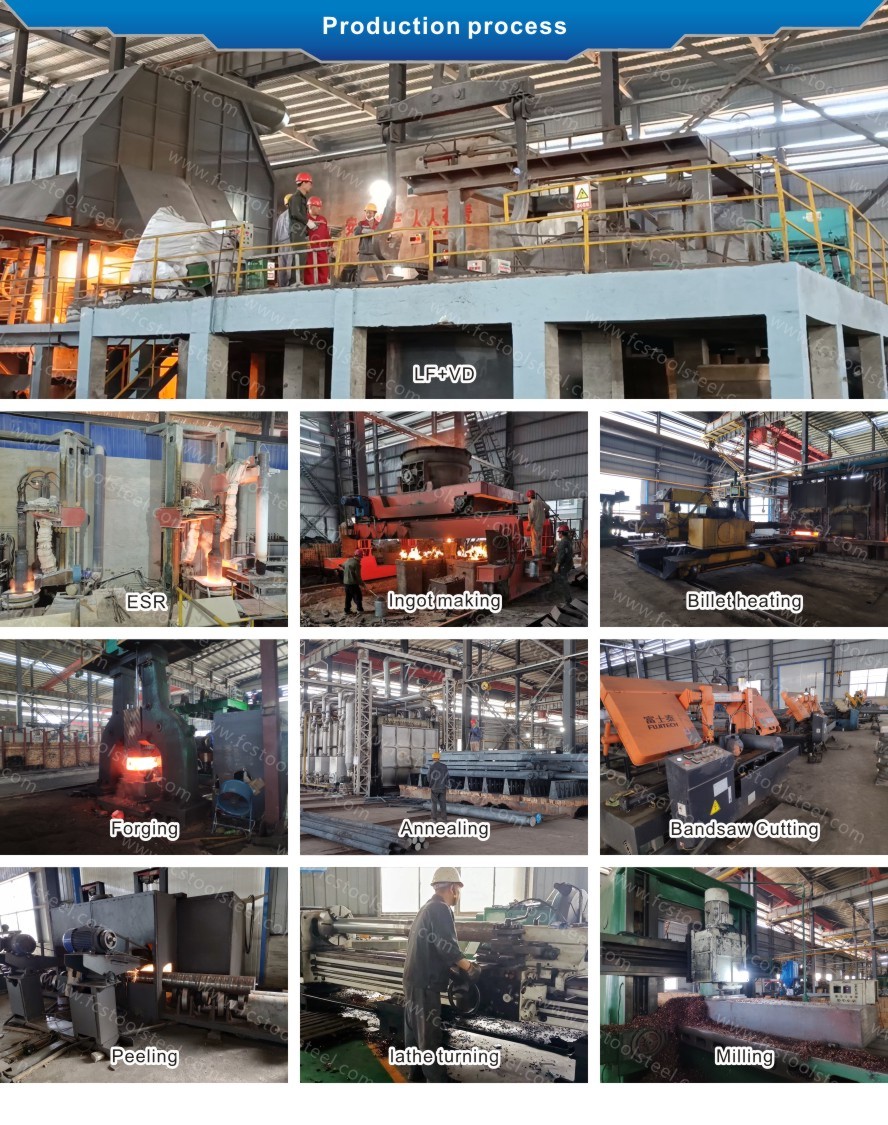
| Smelting and Manufacture Method: | LF+VD+Forged |
| Delivery Condition: | Annealed |
| Delivery hardness: | ≤255 HBS |
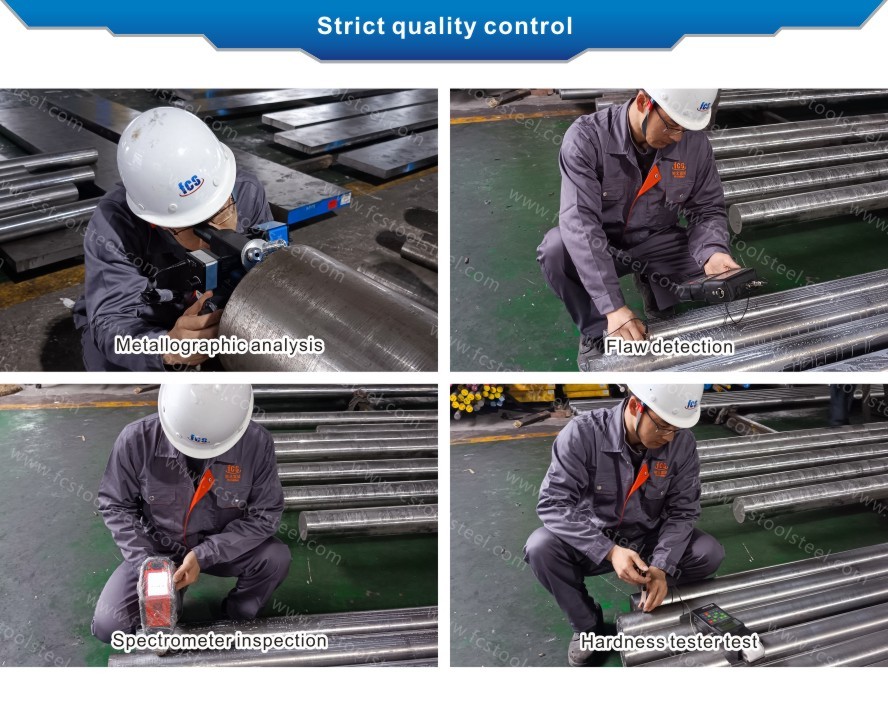
| UT Test Standard: | Sep 1921-84 Class3 D/d,E/e |
K110 STEEL GRADE COMPARISON AND CHEMICAL COMPOSITION COMPARISON
| Standard/Steel Grade | Chemical Composition(%) | ||||||
| C | Si | Mn | Cr | Mo | V | ||
| BOHLER | K110 | 1.55 | 0.30 | 0.30 | 11.30 | 0.75 | 0.75 |
| ASTM | D2 | 1.40~1.60 | ≤0.60 | 0.10~0.60 | 11.00~13.00 | 0.70~1.20 | 0.70~1.10 |
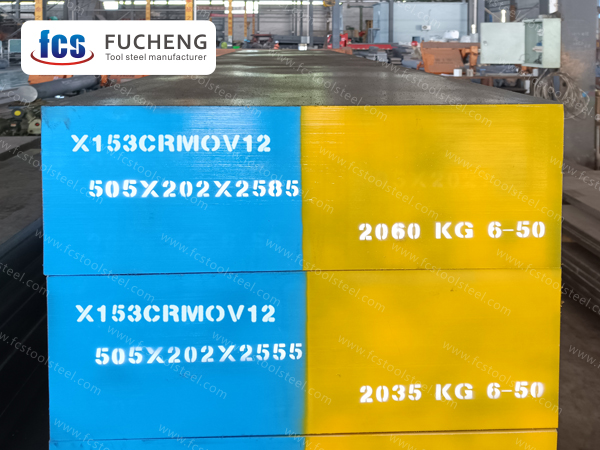
| DIN/W-Nr. | X153CrMo12/1.2379 | 1.45~1.60 | ≤0.60 | 0.10~0.40 | 11.00~13.00 | 0.70~1.00 | 0.70~1.00 |
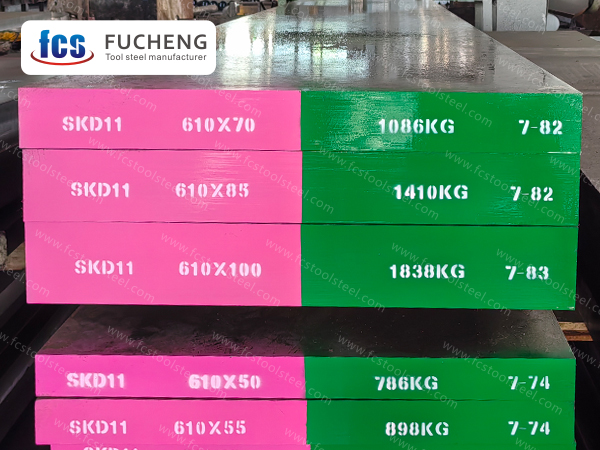
| JIS | SKD11 | 1.40~1.60 | ≤0.40 | ≤0.40 | 11.00~13.00 | 0.80~1.20 | 0.20~0.50 |
APPLICATION
K110 steel is suitable for heavy cutting tools, high-efficiency shearing cold stamping dies, cutting scissors, sheet cutting, circular hobs, deep drawing dies and cold extrusion dies.
K110 STEEL CHARACTERISTICS
After quenching, the hardness of K110 steel can reach 60-62HRC, and it can still maintain high hardness and wear resistance in high-temperature tempering state. This makes K110 steel particularly suitable for manufacturing cold work molds and cutting tools that can withstand high loads and wear.
K110 steel has excellent dimensional stability and small heat treatment deformation, making it suitable for manufacturing precision molds and cutting tools. It can effectively ensure machining accuracy and service life. K110 steel performs well in precision punching, cold extrusion and other fields.
K110 steel has better toughness than ordinary high carbon and high chromium steel. It can withstand certain impact loads while maintaining high hardness, and is not prone to brittle fracture. It is suitable for making tools that require both wear resistance and toughness.
K110 steel has excellent tempering stability and can maintain excellent mechanical properties even after high-temperature tempering, which enables K110 steel to maintain stable performance under complex working conditions.
K110 steel has good mechanical processing performance, with moderate hardness in annealed state, making it easy to perform cutting, drilling and other processing operations. At the same time, it has good hardenability and is suitable for manufacturing large molds.
K110 steel has a certain degree of corrosion resistance, but due to the combination of most chromium elements with carbon to form carbides, rust prevention measures still need to be taken in humid environments to prevent surface corrosion.
The wear resistance of K110 steel is significantly better than that of ordinary tool steel. Its microstructure contains a large amount of high hardness carbides, and its service life can reach 3-5 times that of ordinary steel under the same working conditions.
Physical Properties
Temperature (°C) 20
Density (kg/dm³) 7.67
Thermal conductivity (W/(m.K)) 23.9
Specific heat (kJ/kg K) 0.47
Spec. electrical resistance (Ohm.mm²/m) 0.65
Modulus of elasticity (10³N/mm²) 200
K110 STEEL HEAT TREATMENT INSTRUCTIONS
Annealing
Heat to 800–850 °C (1472–1562 °F), furnace-cool at 10–20 °C/h (18–36 °F/h) to ~600 °C (1112 °F), then air-cool. Softens steel, relieves internal stress, boosts machinability.
Stress Relief
For heavily machined/complex K110 parts: heat to 650–700 °C (1202–1292 °F), hold 1–2h in neutral atmosphere, furnace-cool slowly. Reduces residual machining stress, prevents deformation.
Hardening
Heat to 1030–1070 °C (1886–1958 °F), hold 15–30 mins after temp stabilization. Quench options:
Oil: Balances hardness & toughness
Salt bath (220–250 °C/500–550 °C): Precise control, minimal deformation
Air/gas: For intricate/sharp-edged tools to avoid cracking
Tempering
Temper right after hardening, follow official chart for target hardness. Temper ≥3 times, hold ≥2h each (or 1h per 20mm thickness), air-cool post-cycle. Final temper 30–50 °C below max temp for extra stress relief & dimensional stability.