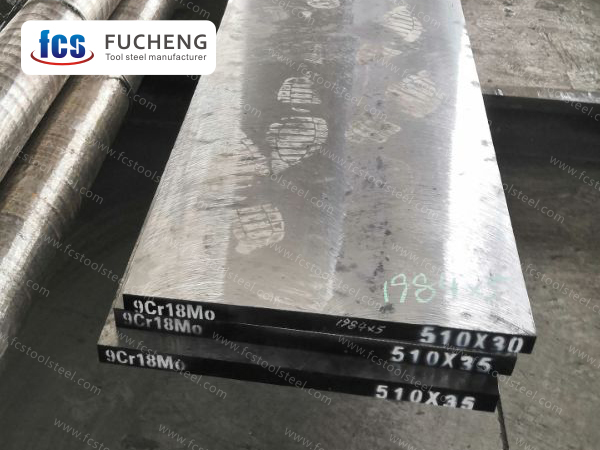

440C Plastic Mould Steel
440C steel is a high carbon, high chromium martensitic stainless steel known for its high hardness, wear resistance, and corrosion resistance. It is widely used in fields such as cutting tools, bearings, and medical devices.
- Fucheng steel
- China
- 1 Month
- 2000 Tons/Month
440C STEEL
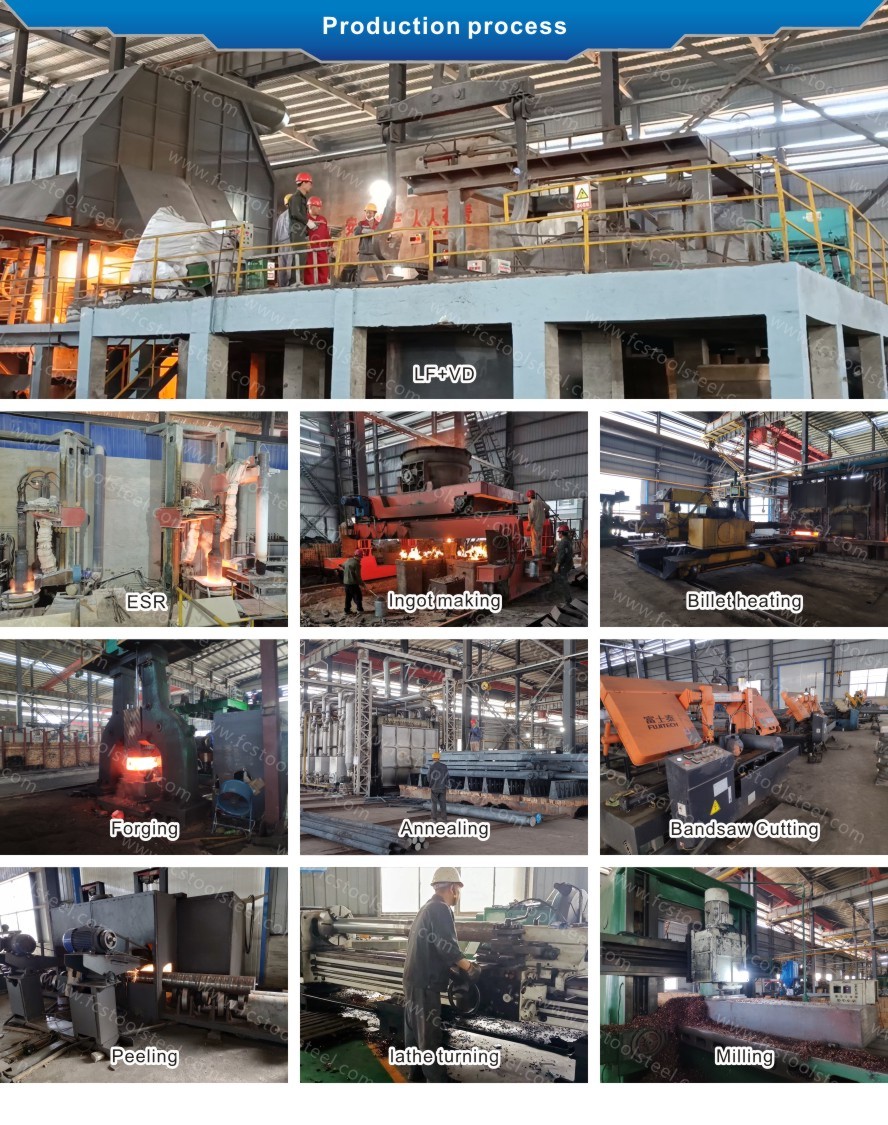
| Smelting and Manufacture Method: | LF+VD+Forged |
| Delivery Condition: | Annealed |
| Delivery hardness: | ≤255 HBS |
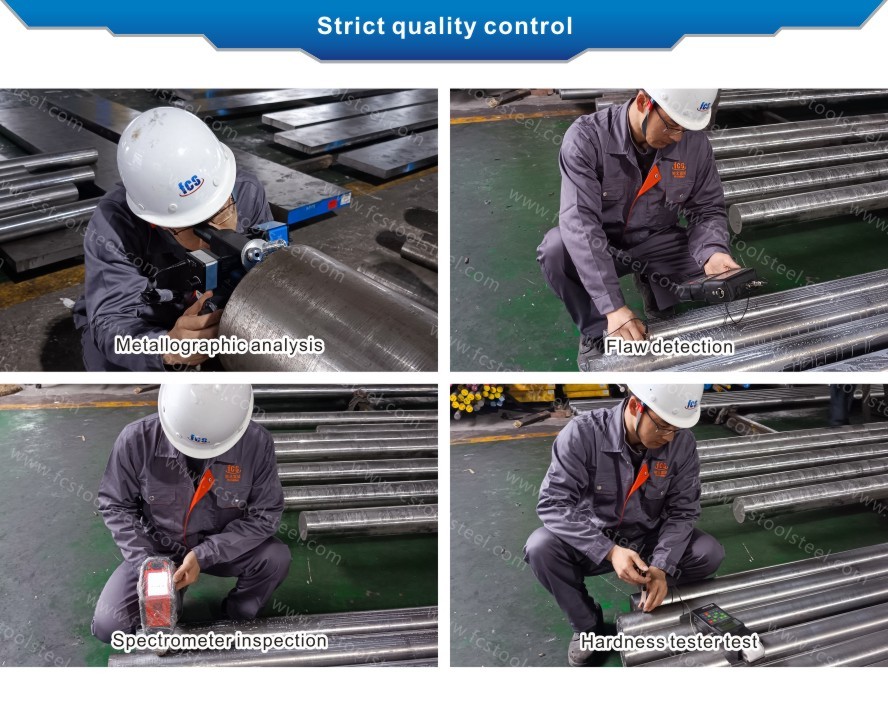
| UT Test Standard: | Sep 1921-84 Class3 D/d,E/e |
440C STEEL GRADE COMPARISON AND CHEMICAL COMPOSITION COMPARISON
| Standard/Steel Grade | Chemical Composition(%) | |||||
| C | Si | Mn | Cr | Mo | ||
| ASTM | 440C | 0.95~1.20 | ≤1.00 | ≤1.00 | 16.00~18.00 | ≤0.75 |
| GB | 9Cr18Mo | 0.95~1.10 | ≤0.80 | ≤0.80 | 16.00~18.00 | 0.40~0.70 |
APPLICATION
440C steel is mainly used to manufacture bearing parts working in corrosive environment and unlubricated strong oxidation atmosphere. 440C steel has good dimensional stability at high temperature, so it can also be used as corrosion-resistant high temperature bearing steel. In addition, it can also be used to manufacture high-quality knives, such as medical scalpels, scissors, nozzles, bearings, etc.
440C STEEL CHARACTERISTICS
440C steel is a high carbon and high chromium martensitic stainless steel with good corrosion resistance, wear resistance, and hardness. It is commonly used in the manufacturing of mechanical parts such as cutting tools, bearings, valves, pumps, as well as in the fields of medical equipment, aerospace, and automotive components.
The chemical composition of 440C steel includes elements such as carbon, chromium, molybdenum, manganese, silicon, phosphorus, and sulfur. Among them, the carbon content is relatively high, usually between 0.95% and 1.20%, which makes 440C steel have high hardness and wear resistance. The chromium content is also very high, usually between 16.0% and 18.0%, which makes 440C steel have good corrosion resistance.
The mechanical properties of 440C steel include yield strength, tensile strength, elongation, and hardness. Its yield strength is usually above 800MPa, tensile strength is usually above 1000MPa, elongation is usually between 10% and 15%, and hardness is usually between 58HRC and 62HRC.
The corrosion resistance of 440C steel mainly depends on its chromium content. Chromium is an element that can form a dense oxide film, which can prevent further corrosion of the steel surface. 440C steel has a high chromium content, therefore it has good corrosion resistance and can be used for a long time in humid and corrosive environments.
The wear resistance of 440C steel is also good, due to its high carbon content and hardness. The hardness of 440C steel is usually between 58HRC and 62HRC, which makes it resistant to wear and scratches and suitable for manufacturing parts that require high wear resistance such as cutting tools and bearings.
It should be noted that the processing performance of 440C steel is poor, and appropriate processing techniques and tools need to be used for processing. Meanwhile, due to its high carbon content, 440C steel is prone to cracking during welding, and appropriate welding processes and materials need to be used to avoid this situation.
PHYSICAL PROPERTIES
| Physical Parameter | Value Range |
|---|---|
| Density | 7.7~7.8 g/cm³, the industry standard value is 7.8 g/cm³ |
| Melting Point | 1370~1480℃ |
| Thermal Conductivity | 24.2 W/(m·K) (at room temperature) |
| Specific Heat Capacity | 460 J/(Kg·K) |
| Elastic Modulus | 200 GPa |
| Coefficient of Thermal Expansion | 10.2×10⁻⁶ /℃ (in the range of 0-100℃) |
| Resistivity | 0.6 μΩ·m |
In terms of mechanical properties, the hardness of 440C steel in
annealed state is ≤269HB. After standard quenching and tempering, the
hardness of 440C steel can reach 58~60 HRC (up to 62
HRC), making it one of the hardest commercial stainless steels. The
tensile strength of 440C steel can reach 1750~2030 MPa, but its
toughness and ductility are low, and its ability to bear dynamic load is
limited.
HEAT TREATMENT PROCESS
Annealing: Heat the workpiece to 800~920℃ and cool it slowly. The purpose is to reduce the hardness for machining. After annealing, the hardness of 440C steel is ≤269HB.
Preheating: It is recommended to preheat to 649℃~816℃ before formal quenching to reduce the temperature difference inside and outside the workpiece and lower the risk of deformation.
Quenching: Heat to 1010~1070℃ (the optimized industrial temperature is 1040~1052℃), and adopt oil cooling to obtain the high-hardness martensitic structure required by 440C steel. For specific precision parts, cryogenic treatment at -70℃ can be added to further reduce retained austenite and improve dimensional stability, but it has no obvious effect on the final hardness.
Tempering: Choose the temperature according to your demand. For high hardness, select low-temperature tempering at 100~180℃ and cool quickly, the hardness can be stably maintained at 58~60HRC; to balance hardness and toughness, select tempering at 200~300℃, and the impact toughness reaches the peak when tempered at 300℃. Note: 440C steel in high hardness state is prone to hydrogen embrittlement. If the workpiece is exposed to hydrogen-producing environment during processing, a post-processing baking process is required to eliminate the risk.
PROCESS NOTES
The heat treatment parameters of 440C will be fine-tuned according to the size, shape and final performance requirements of the workpiece. When the austenitizing temperature is higher than 1000℃, the corrosion resistance can be improved, but the toughness will be slightly reduced; the corrosion resistance will decrease slightly after tempering.